Monday, 11 June 2012

Guardian: Medical body in fight to extend HPV vaccination to gay men

Including young homosexuals would reduce deaths from preventable cancers and lessen demand for costly treatments
http://www.guardian.co.uk/society/2012/jun/10/hpv-vaccination-gay-men-lobby

Barry Neild, The Observer, Sunday 10 June 2012

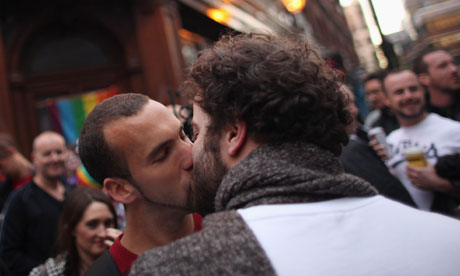
Pub gay men


Sexually active gay men are the only group still at high risk of contracting HPV. Photograph: Dan Kitwood/Getty Images

A group of influential doctors, men's health charities and senior politicians is calling for the vaccination of gay men against a cancer-causing sexually transmitted virus from which the NHS already protects young heterosexuals.

The British Association of Sexual Health and HIV, backed by the British Medical Association, the Terrence Higgins Trust and several MPs, wants government health advisers meeting this week to recommend extending a vaccination scheme currently restricted to adolescent girls.

Guardian: 'Sexual depravity' of penguins that Antarctic scientist dared not reveal


Landmark polar research about the Adélie penguin's sex life by Captain Scott's expedition, deemed too shocking for the public 100 years ago, is unearthed at the Natural History Museum

http://www.guardian.co.uk/world/2012/jun/09/sex-depravity-penguins-scott-antarctic 
Robin McKie, science editor
guardian.co.uk, Saturday 9 June 2012 11.31 BST

Dr George Murray Levick's notebook

Dr George Murray Levick's observations of Adélie penguins were recorded in his notebook. Photograph: R Kossow/NHM

It was the sight of a young male Adélie penguin attempting to have sex with a dead female that particularly unnerved George Murray Levick, a scientist with the 1910-13 Scott Antarctic Expedition. No such observation had ever been recorded before, as far as he knew, and Levick, a typical Edwardian Englishman, was horrified. Blizzards and freezing cold were one thing. Penguin perversion was another.

Telegraph: Homosexuality akin to rape and prostitution, Polish nursing teaching books claim

Homosexuality is on a par with rape and prostitution, according to official teaching materials for Poles studying to be nurses and midwives.

http://www.telegraph.co.uk/news/worldnews/europe/poland/9319151/Homosexuality-akin-to-rape-and-prostitution-Polish-nursing-teaching-books-claim.html
12:08PM BST 08 Jun 2012 By Matthew Day, Warsaw

Teaching books refer to homosexuality as a "pathology" and the subject often comes under the section of "sexual problems" where students are instructed on "how to identify and provide assistance in situations of sexual assault and sexual disorders".

A multiple choice question from a 2011 exam paper on gynaecology read: "Homosexuals are particularly dangerous socially and seduce individuals by ..." Students are then given a number of options including "abnormal sexual drive" and "prostitution".

The curriculum content has been condemned by equal rights campaigners in Poland, a country where conservative attitudes towards homosexuality still hold sway over large parts of the population.

"This is a particularly dangerous incident of homophobia," said Agata Chaber, president of the Campaign Against Homophobia. "Official information in course curriculum is regarded as reliable and verified, and therefore very few people will question it." Their anger has been intensified by the fact that the material went unchallenged for some 10 years despite reviews by leading Polish medical scientists.

Agnieszka Kozlowska-Rajewicz, the Polish government's plenipotentiary for equal treatment, described the course content as "unacceptable", adding that she had written to the health ministry calling for an "immediate cease" to its teaching.

The health ministry has said it will initiate a review of the teaching material with the aim of bringing it up to date but this may take some time owing to legal procedures.

This response promoted immediate accusations of foot-dragging.

"For 10 years the ministry did not mind that nurses and midwives learnt content that was both discriminatory and hurtful for sexual minorities, and now it doesn't seem to mind that the content will still be taught until it ends a bureaucratic procedure for establishing new programmes," commented Zosia Jablonska, an equal-rights campaigner.

The scandal raises further question marks over Poland's liberal credentials following racism allegations in a BBC Panorama documentary. Although homophobic attitudes in Poland are on the wane they are still encounter conservative opposition, especially in the countryside.

LA Times: Gay teens less likely to be happy, nationwide survey finds

Even as barriers to equality fall, gay and lesbian teens report they still struggle with harassment and identity issues more than their straight peers do.

http://www.latimes.com/health/la-me-gay-youth-20120607,0,4443551.story

By Rebecca Trounson, Los Angeles Times
June 6, 2012, 9:02 p.m.

It's not easy growing up gay in America, despite the nation's increasing acceptance of same-sex marriage and other issues of gay equality.

Gay and lesbian teenagers across the United States are less likely to be happy, more likely to report harassment and more inclined to experiment with drugs and alcohol than the nation's straight teens, according to a new nationwide survey of more than 10,000 gay and lesbian young people.

The survey, which will be released Thursday by the Human Rights Campaign, aWashington, D.C.-based civil rights group, is described as one of the largest ever to focus on the nation's gay youth. It was conducted online and involved 10,030 participants aged 13 to 17 who identified as gay, lesbian, bisexual or transgender. It also included interviews with about 500 13- to 17-year-olds who composed the poll's "straight" population.

The study paints an often stark picture of the challenges of growing up gay in this country, even as same-sex marriage gains support among many Americans and other legal and cultural barriers to gay equality begin to fall.

The survey showed, for example, that half of all gay and lesbian teens reported being verbally harassed or called names at school, compared with a quarter of non-LGBT kids. About twice as many gay and lesbian respondents as straight teens also said they had been shoved, kicked or otherwise assaulted at their schools, with 17% of LGBT teens and 10% of straight youths reporting such assaults.

Fewer than half of gay teenagers said they believe their community is accepting of people like them, and 63% said they would need to move to another town or part of the country to find acceptance. Just 4 in 10 gay teens reported being happy, compared with nearly 7 in 10 of their straight peers.

And more than twice as many gay (52%) as non-gay (22%) respondents said they had experimented with drugs or alcohol.

Child welfare advocates who reviewed the study before publication praised it for shedding light on a population that is difficult to reach and in need of help from government agencies and others.

Linda Spears, vice president of policy for the Child Welfare League of America, said the study bears out "our worst fears about LBGT kids. These kids are often so vulnerable in the way their lives are being led because of the lack of support they have. They need what all young people need, parents and others who are there for them and nurture their development."

Chad Griffin, the new president of the Human Rights Campaign and an advocate for same-sex marriage, said the survey "is yet another reminder that we still have a lot to do in this country so that young people can grow up healthy."

Griffin, who helped organize the legal fight against Proposition 8, California's ban on gay marriage, said he hopes the report will inform policymakers and serve as a reminder to parents, schools and elected officials about the challenges facing a vulnerable population.

"These are young people," he said. "They worry about which hall they can walk down at school, which table they have to avoid in the lunchroom, what happens at church on Sunday and whether they need to hide their identity from their family."

But the survey also showed that many gay teens find safe havens among their peers, on the Internet and in their schools. Nearly 3 in 4 gay teenagers said they were more honest about themselves online than elsewhere and 67% said their schools were "generally accepting" of gay people.

In interviews this week at L.A.'s Gay and Lesbian Center, several young people spoke about the survey's findings and their own experiences coming to terms with their LGBT identity.

Jonathan McClain, a 22-year-old from Altadena, said he identified strongly with part of the study showing that many young gays and lesbians feel forced to change their identities almost hour by hour, depending on where they are and who's around. Many LGBT kids are more likely to be "out" at school than they are with their families.

"Sometimes you're out of the closet, sometimes you have to put yourself back in and watch what you say and how you act," said McClain, who volunteers at the center.

McClain, who came out after he graduated from high school, said he had never directly experienced harassment.

That was not the case with others interviewed, including Edwin Chuc, from Los Angeles, who said he had been beaten up in middle school and ended up with broken ribs. Chuc said he had lived on the streets for several years and abused drugs and alcohol before turning his life around.

Now a confident 19-year-old who will attend USC in the fall, Chuc said his parents are much more supportive now than they were when he first came out. "I'm happy and I have people I can turn to," he said.

Logan Woods, 18, of Manhattan Beach, said middle school was tough for him too, but high school, at the private Vistamar School in El Segundo, has been much better, with good friends and a strong gay support group among the students.

"It's getting easier for me to live spontaneously and not feel like I have to plan everything out for fear of being hurt," he said.

The survey was conducted online from April 16 through May 20. It was advertised through social media, as well as through LGBT youth centers across the country. The researchers said the survey method is not unusual for targeting hard-to-reach populations but may not represent a truly random sample.

rebecca.trounson@latimes.com

Copyright © 2012, Los Angeles Times

Friday, 8 June 2012

Malta Today: Transgender rights, cohabitation bills expected in coming days – MP

Labour MP Evarist Bartolo says justice minister to present two important bills for House agenda within coming days.

http://maltatoday.com.mt/en/newsdetails/news/national/Transgender-rights-cohabitation-bills-expected-in-coming-days-MP-20120606
Friday 8 June 2012 - 07:30 by Karl Stagno-Navarra

A bill drafted by the Malta Gay Rights Movement to facilitate the legal rights and inclusion of transgender people, is expected to tabled in the House in the coming days.

Labour MP Evarist Bartolo told MaltaToday that justice minister Chris Said had informed him both the transgender bill, which he presented to the House, and the cohabitation bill are to be put on the agenda of the House in the coming days.

"It's brought me great joy learning that the transgender rights bill will be finally on the agenda, having piloted this bill," Bartolo said.

One of the biggest problems facing transgender individuals is seeking a change of their sex in birth certificates after having undergone gender reassignment surgery.

Aditus chairperson Neil Falzon, who drafted the bill for the MGRM, had said transgender individuals face an "unwarranted and unnecessary interference and imposition" in their private lives after having undergone costly gender reassignment surgery, which is not available in Malta, and does not fall under the national social security health care.

The proposed act would morph the process from a judicial one to an administrative one, as well as removing the prerequisite that the individual seeking to have their birth gender changed be unmarried.

The bill also proposes that any changes to one's gender does not influence or affect any obligations a person might have as a parent. The bill proposes a secret register of transgender people, so that the act itself does not incur legal or administrative burdens.

Transgender is the state of one's gender identity and does not imply any specific form of sexual orientation.

Gay couples are also set to have their relationship recognised at law in a cohabitation law, first promised in 1998, which will legislate for civil partnerships.

The draft law will provide legal recognition to non-married co­habiting individuals.

Thursday, 7 June 2012

Malta Today: Gay Christians disappointed at Vatican’s censure of nun’s ‘sexual ethics’ book

http://www.maltatoday.com.mt/en/newsdetails/news/national/Gay-Christians-disappointed-at-Vatican-s-censure-of-nun-s-sexual-ethics-book-20120607
Thursday 7 June 2012 - 11:51

Maltese gay Christian group Drachma says Roman Catholic Church is limiting 'good news' to elite group of people.

Drachma, the Maltese gay Christian group, has joined a call by the European Forum of Lesbian, Gay, Bisexual and Transgender Christian Groups, warning the Roman Catholic Church that it was limiting the teachings of the Christ to "a select, elite group of people within society".

The group was replying to the censorship of the book 'Just Love' by theologian Sr. Margaret Farley, which deals with Christian sexual ethics, by the Vatican's former inquisition office, the Congregation for the Doctrine of the Faith.

 "We believe that the good news is universal and is to be shared with all people of good will. Sr. Farley's book 'Just Love' succeeded to reach out to such people who would otherwise think they have no place in the Church and it offered hope," Diane Xuereb, the co-president of the European forum, said.

According to the Vatican, Farley's book - now an Amazon.com top 20 bestseller - affirms positions that are in direct contradiction with Catholic teaching in the field of sexual morality, and has warned the faithful that her book is not in conformity with the teaching of the Church.

Farley broadly argues in her book that divorce, homosexual acts and unions, and masturbation cannot be contrary to the faith under certain conditions.

"Farley's book offers fresh perspectives and practical tools to navigate amidst the various moral dilemmas that millions of faithful may encounter, in their daily, real, day-to-day lives. It also enhances ecumenical dialogue.

"Whilst Sr Farley retains a solid Christian framework she opens up immense possibilities for those who are honest about their lives and sexualities and want to retain their Christian faith," Xuereb said.

The European forum also said the Congregation's censorship was a sign that the Vatican refuted to engage in matters on human sexuality, denying decades of scientific data and sing force against those trying to espouse faith and reason on human sexuality.

"The CDF dismisses the faith experience of thousands of LGBT Christians, our families and friends. It is interesting to note that in a time of regular scandals by the hierarchy and those at the Vatican - also about sexual matters, it is an ethicist that is being punished!" Xuereb said.

"Many people who have been censored in the past received apologies later - usually after their death, some have also been canonized. We believe that history repeats itself.  Unfortunately it seems that the hierarchy does not want to learn from its past mistakes."

Vatican Insider: Berlin’s cardinal and same-sex couples

http://vaticaninsider.lastampa.it/en/homepage/world-news/detail/articolo/berlino-berlin-woelki-15776/
06/ 6/2012 by ANDREA TORNIELLI, Rome

Archbishop Woelki recently gave a speech on stable same-sex relations at the Katholikentag convention, but a clarification of his statement was later given by his spokesman

Archbishop Rainer Maria Woelki, the youngest of the current members of the Sacred College of Cardinals, is at the centre of a controversy over a statement he made on homosexuality.

Fifty five year old Woelki, a bishop since 2003 and archbishop since 2011 was created cardinal by Benedict XVI at the last consistory held in February 2011. In a recent speech at the Katholikentag convention held between 17 and 20 May in Mannheim, he stated:

 "I believe we should agree and indeed we do agree on the fact that in judging this type of relation or relationship there is a big difference in judgement when people take responsibility for one another, when engaged in a long-term relationship as couples do in heterosexual relationships."

These words suggested the cardinal was opening up to stable same-sex relationships. But the Archbishop of Berlin's spokesman stated that Woelki's declaration was allegedly too "concise" and explained that the cardinal had not intended to put same-sex unions on a par with marriage. 

Readers will recall that the issue recently resurfaced in Austria, when a young man living in a registered partnership with another male was elected to the pastoral council of a small village near Vienna.

Wednesday, 6 June 2012

Politico: Gay marriage advocates gain corporate support

http://r.smartbrief.com/resp/dGjiCmmWfYeziUdwfCnXbQcOyiCY?format=standard
3.6.2012 by Abby Philips

One by one, national corporations like Microsoft, Starbucks, Boeing and Google are wading into the once-risky business of taking a position supporting gay marriage in states across the country.

Nowhere is that more apparent than in the lawsuit challenging the Defense of Marriage Act, which a federal appeals court called unconstitutional on Thursday. Forty-eight companies, including Nike, Time Warner Cable, Aetna, Exelon Corp., and Xerox had signed a brief arguing that the law negatively affected their businesses.

But the real test will come in November, when voters in four states — Maryland, Minnesota, Maine and Washington — will head to the polls. To date, gay marriage advocates have yet to win a statewide ballot initiative but hope corporate support and money will help turn the tide.

Last year, 25 executives including the CEOs of Goldman Sachs, Viacom and Alcoa lobbied New York legislators to approve same-sex marriage.

In January, Microsoft, Boeing, Vulcan and RealNetworks were among those who voiced their support for a bill approving gay marriage in Washington state.

The corporate activism is a change from as little as five years ago, when major companies shied away from same-sex marriage issues in order to avoid a backlash. Social conservative groups like the American Family Association systematically targeted companies like Home Depot and Ford for their support of gay rights organizations.

"Earlier on there was more risk than reward," said Bob Witeck, a consultant who works with corporations on gay, lesbian and transgender policies. "Now there's far more talk about the reward and less about the risk."

The 48 businesses and nearly two dozen other employer organizations that signed on to a federal court brief opposing DOMA represent a "sea change" in the views of the business community, said Beth Boland, an attorney who worked on the brief.

In the brief, the companies say DOMA, which defines marriage as the legal union of one man and one woman, is expensive to comply with and forces businesses to treat legally married couples of the same sex differently from couples of different sexes.

"I see a seismic shift in the business community in the last five to 10 years," Boland said. "I can't even begin to state how different these issues are perceived within the business community.

"I think there is a symbolic factor of showing that a growing number of vocal members of the business community want to come forward and indicate that as a matter of their own internal employee policy they see this differentiation as negatively affecting their business," she added.

Gay marriage advocates like the Gay and Lesbian Advocates and Defenders, Human Rights Campaign and Third Way, a moderate Democratic think tank, are leading the charge to hone a pro-business strategy ahead of November's referendums.

Eventually, they expect corporations to play a role in lobbying moderate Republicans and Democrats in Washington.

"There's no doubt that American businesses will be central to the dismantling of DOMA," Human Rights Campaign President Joe Solmonese said. "The business case against DOMA could not be stronger. Not only does DOMA hurt employees but it also costs businesses a significant amount of money."

Starbucks's endorsement in the Washington state campaign has been good for business, CEO Howard Schultz told shareholders in March.

"I think any decision of this type or magnitude has to be made with great thoughtfulness. I would assure you that a senior team at Starbucks discussed this and it was, to be candid with you, not something that was a difficult decision for us," Schultz told a shareholder and National Organization for Marriage representative who had expressed concern about the company's decision at the meeting.

"Candidly, since we made that decision, there has not been any dissolution whatsoever in our business," he added.

Jonathan Baker, director of the Corporate Fairness Project for the NOM, said the group, which has begun a campaign to oppose corporate support for same sex-marriage, isn't looking to recruit business support for traditional marriage.

"A lot of businesses were getting into a pro same-sex marriage position. Our goal was to support the other side of that," Baker said. "Our goal is not to have Target supporting traditional marriage. Our goal is to have Target stay neutral."

Baker added: "Marriage isn't terribly pertinent to their business."

NOM launched a "Dump Starbucks" campaign this year, challenging the coffee company's vocal support for gay marriage. It is also proposing a Bank of America shareholder resolution aimed at enshrining freedom of speech for employees who support or oppose gay marriage.

In North Carolina, all of the Fortune 500 companies in the state — including Bank of America and Duke Energy — stayed on the sidelines during last month's referendum to enact a same-sex marriage ban, The New York Times reported. The referendum passed by a double-digit margin, raising questions about whether the issue is still too hot for many corporations to handle.

Jeremy Kennedy, campaign manager for the anti-referendum organization Protect all North Carolina Families, said corporations in the state split the difference by pressuring lawmakers to include language in the amendment allowing companies to offer domestic-partner benefits to their employees. But they sat out when it went to the voters.

Duke Energy CEO Jim Rogers did make a forceful personal statement against the amendment, but his company declined to take an official position. "There was real hesitancy on the part of corporations to stick their neck out officially as a company," Kennedy said.

Many had read the tea leaves — and the polling data — that clearly showed the amendment was likely to pass by a wide margin in the heavily evangelical Christian state.

"I don't know that a Bank of America or Duke Energy would have made that big of a difference on these issues," Kennedy said. "People were looking to their pastors, their Bible and their faith on this issue."

Large corporations have also been slow to issue full-throated statements opposing a Minnesota constitutional amendment banning same-sex marriage, which is on the ballot in November, but there are signs the support may eventually come.

A small group of Minnesota-based business executives, including Marilyn Carlson Nelson, CEO of Carlson Companies which owns T.G.I. Friday's and Country Inns & Suites, and Bill George, former CEO of Medtronic, have penned editorials opposing the constitutional amendment.

And Target, which faced intense backlash in 2010 for donating to a Minnesota group that supported an anti-gay candidate, appears to have made an about-face.

Target is holding a "Wear It With Pride" T-shirt promotion that would benefit groups opposing the constitutional amendment. In a statement, Target cited the company's "long history of supporting the LGBT community through giving, volunteerism and event sponsorship and participation" and encouraged its employees to "exercise their right to vote" in November's referendum.

Even if companies aren't supporting gay marriage efforts, what's important is they're not fighting them, said Marc Solomon, national campaign director of Freedom to Marry.

"I don't think you see any corporations taking stances against equality," he said. "You're either taking a stance in favor of equality or you don't take a stance at all. We've certainly defeated our opponents with respect to getting corporations to take an anti-gay stance."

© 2012 POLITICO LLC
Tuesday, 5 June 2012

Malta Today: Heartening change in attitudes to put gay unions on political agenda

Malta is joining in the shift in attitude that has spread over Europe in accepting the reality of same-sex families.

http://www.maltatoday.com.mt/en/newsdetails/news/national/Heartening-change-in-attitudes-to-put-gay-unions-on-political-agenda-20120604
National Tuesday 5 June 2012 - 11:40 by Matthew Vella

Malta is joining in the shift in attitude that has spread over Europe in accepting the reality of same-sex families, according to Silvan Agius, a policy director of the International Lesbian, Gay, Bisexual, Trans- and Intersex Association of Europe. A MaltaToday survey last week found 60% of 18- to 34-year-olds agreed with the introduction of marriage for same-sex couples, in a clear indication of a generation gap in values that finds just 23% of those over 55 years in similar agreement.

Most importantly, the survey shows support for gay marriage increasing by 13 points since 2007, when the first MaltaToday survey on this issue was conducted.

But overall, an absolute majority of 51.2% is opposed to the introduction of gay marriages while 42% agree with gay marriage. And those in favour of same-sex marriages include a significant 9% who specified that they agree with the introduction of same-sex marriage but disagree with these couples adopting children.

"It may appear 'astounding' as MaltaToday reported, but only when comparing Maltese attitudes today with those of the Maltese public some time ago. The truth though is that such a shift has taken place across all Western societies, Malta included," Agius told MaltaToday.

Seven European countries have already adopted gender-neutral marriage laws, providing equal rights and recognition to same-sex and different-sex couples. Others such as Finland, Denmark and Luxembourg currently have draft laws for adoption tabled in parliament, while the French President Francois Hollande has committed France to follow suit in the next year. Scotland and the rest of the United Kingdom are conducting public consultations on the opening of marriage to same-sex couples as well.

Agius says it's representative of a huge transnational shift towards equal recognition of all families.
"It's happening all around Malta, and the Maltese public knows that and none of the doom and gloom, such as the meltdown of heterosexual marriage, forecasted by those opposed to marriage of same-sex partners has taken place."

The coordinator of the Malta Gay Rights Movement Gabi Calleja also acknowledges the shift towards greater acceptance. "With respect to the increase in acceptance of marriage equality by the younger age group, the survey seems to mirror others carried out with university students which is encouraging. We do believe there's been a shift towards greater acceptance, but less so where parenting issues are concerned."

But although support for same-sex marriages is strongest among 18- to 34-year-olds, the largest increase in support was registered among 35- to 54-year-olds. Among this category, agreement with same-sex marriage has increased by a staggering 22 points since 2007 - when MaltaToday last carried out a similar survey.

The indications are that same-sex marriage, which so far is not embraced by any party, will become a key policy that future governments will find it hard to ignore. Agius is convinced about this.
"As time goes by, the Maltese public's awareness will lead them to ask: 'Why should marriage remain a heterosexual privilege rather than a universal right for couples who want to commit to one another?'"

Joseph Carmel Chetcuti, the author of A Queer History of Malta, charts the vicissitudes of the Maltese gay community, and says the "heartening" results of the survey were a direct consequence of more gay men and lesbians coming out and taking pride in their sexuality.
"Of course, not all gay men and lesbians are in favour of marriage. Some are strongly opposed to what is, after all, a patriarchal institution as some gay men and lesbians struggle to be like the rest of society rather than taking pride in their difference. But every gay man and lesbian should have the right to decide for themselves," Chetcuti told MaltaToday from Australia, where he practices law.

But, he adds, putting same-sex marriage on the agenda is another battle to be fought. "There is little doubt that we shall win the war against a conservative establishment with its outdated traditional values: values that do not respect the needs of each and every human being."

University lecturer and gay rights blogger Patrick Attard says it is interesting to note that percentage-wise there are twice as many Labour voters in favour of gay marriage than PN voters. Although 63% majority of Nationalist voters oppose same-sex marriages, nearly a third agree with this radical social reform, while 50% of Labour voters are in favour of gay marriages.
"It is important to note that we are almost completely invisible in the PN media," Attard says, who feels same-sex unions may be a defining criteria in the upcoming election. "It is important however to remain focused and not believe any last-minute promise before the upcoming election unless there are concrete results."

Undoubtedly, the feeling of an international wave of gay pride and support prompted by Barack Obama's move in favour of gay marriage in the United States, has had powerful results.

"Malta does not exist in a vacuum. There has been a global shift in legal and social attitudes towards the recognition of same-sex partners and their families," Silvan Agius says.

"The MGRM has worked incessantly to challenge myths about gays and lesbians, and same-sex unions... but very importantly, many Maltese people have gay and lesbian couples as their friends and share the sense of injustice when they learn about discrimination on parents' days, accessing a bank loan for a family home, or in filling joint tax forms. This first-hand experience makes the issues at stake real, and the need to address them pressing."

Monday, 4 June 2012

EU: "Discrimination hampers development" – Commissioner Piebalgs launches a new initiative to fight discrimination in developing countries

http://europa.eu/rapid/pressReleasesAction.do?reference=IP/12/547&format=HTML&aged=0&language=EN&guiLanguage=en

European Commission - Press release
Brussels, 01 June 2012 - EU Commissioner Piebalgs today unveiled the launch of a new €20 million package to help fight against any kind of discrimination - whether based on gender or sexual orientation, religion or belief, race or ethnic origin, or disability - which affects millions of people around the world.
The announcement was made during an event at the European Commission. High level speakers exchanged views on how to move ahead towards tolerant democracies as well as the added value of non-discrimination and the promotion of human rights to unlock sources of development and enable inclusive growth.
The EU announced that this new package will be available for NGOs and civil society groups to tackle incidences of any kind of discrimination on the ground.
European Commissioner for Development, Andris Piebalgs, said: "It is clear that no country can develop in the long term when some minorities face serious threats, intimidation and even violence because of who they are. Since I took office, I have put the promotion of human rights and human development at the core of EU development policy. The new package launched today is a clear signal of the EU's determination to help civil society and willing partners to make diversity acceptable and an asset of our societies".
Member of the European Parliament, Michael Cashman, said: "This new call to combat discrimination is part of a shared global agenda for tolerant democracies. The European Commission is right to put so much effort into equality as part of the EU’s development strategy, and we in the European Parliament wholeheartedly support this. Soon we will have to approve the second revision of the Cotonou Agreement. We are sincerely committed to this in partnership with ACP governments and civil society.”
Participants exchanged points of views but also good practices and testimonies from the ground, both within the EU and abroad. UN High Commissioner for Human Rights, Ms Navanethem Pillay, Ernst & Young partner, Ms L. Bingham, as well as NGOs such as "Sexual Minorities Uganda" and Coalition Advocating for the Inclusion of Sexual Orientation (CAISO) from Trinidad and Tobago, participated.
A new support package
€20m euros will be available in the new funding package announced today. It is the first funding specifically set up for the purpose of non-discrimination under the current EIDHR. The funding will be launched through the Commission's Call for Proposals in 2013.
Through its European Instrument for Democracy and Human Rights (EIDHR), the EU is also active in combatting racism and supporting minority groups, for example through the provision of funding to support civil society projects in this area.
The EIDHR has just funded a project to help to improve conditions for the Roma community in Bosnia and Herzegovina, for example. The Roma population suffers a legacy of discrimination in these countries, resulting in widespread poverty, unemployment, homelessness and lack of access to education. The €90,000 funding through the EIDHR aims to help Roma groups achieve greater political representation, promoting the inclusion of minority group's rights in the national constitution through a series of training sessions, national debates and workshops to encourage Roma to become politically active, as well as campaigns to raise awareness of the importance of voting. As a result of the project, 90% of the Roma voted in local elections.
The EIDHR also supports Lesbian, Gay, Bisexual, Transgender and Intersex (LGBTI) groups around the world – monitoring information on LGBTI rights, raising awareness on this issue and supporting individual cases through prison visits and court hearings. It also provides emergency assistance (from psychosocial assistance through to medical care) to the most vulnerable LGBTI people in need of support. Around 80 countries still criminalise same-sex relations, and in seven of these it is still punishable by the death penalty.
For further information
Website of DG Development and Cooperation – EuropeAid
Website of the EU Development Commissioner, Andris Piebalgs
Contacts :
Catherine Ray (+32 2 296 99 21)
Wojtek Talko (+32 2 297 85 51)